
Soil: A Living System
Learn how soil is a living ecosystem filled with organisms that support plant growth and food production. Explore how soil structure, organic matter, and microorganisms work together to create healthy growing conditions.
Article Title:
Soil: A Living System
Description:
Soil is more than just dirt; it is a complex living system that supports plant growth and healthy food production. In this activity, students explore the materials that make up soil and the processes that form it over time.
Target Grade Level:
Grades 5-8
Discipline or Course (Audience):
Physical Science, Earth Science, Life Science, Environmental Science, Biology, Agriculture, CTE, Sustainability, Civics
Time Frame:
45-60 minutes (one to two days)
Teachers may select portions of this article and the processing activity based on time. The system diagram extension is recommended as a Day Two activity.
Suggested Grouping:
Individual
Key Vocabulary:
soil, organic matter, inorganic matter, humus, microorganisms, minerals, soil formation, nutrients, soil ecosystem, regenerative agriculture, topography, weathering
Educator Background:
Soil is a complex mixture of organic and inorganic materials that support plant growth and ecosystem health. Organic materials in soil come from living or once-living organisms, including plant remains, animal remains, and microorganisms. Over time, decomposed organic matter forms humus, a dark, nutrient-rich substance that improves soil fertility and helps plants grow.
Microorganisms play an essential role in soil ecosystems. These microscopic organisms break down plant and animal remains and release nutrients such as nitrogen and phosphorus that plants need to grow. As microorganisms decompose organic matter, they contribute to the nutrient cycle and help maintain fertile soil.
Inorganic materials in soil come from minerals and rock particles created through weathering and erosion. Water and air are also important components of soil that influence plant growth and soil structure.
Soil formation occurs slowly through the interaction of several environmental factors, including parent material, climate, organisms, location, and time. These factors influence the composition, structure, and fertility of soil in different regions. Over time, soils develop layers called horizons, which together form a soil profile.
Understanding soil as a living system helps students recognize the importance of soil health in agriculture and environmental sustainability. Regenerative farming practices focus on protecting soil organisms, increasing organic matter, and reducing soil disturbance in order to restore healthy soil ecosystems.
In this activity, students investigate how organic matter, minerals, water, and microorganisms interact to create fertile soil and how environmental factors influence soil formation. Students connect their understanding of soil systems to regenerative farming practices that protect soil health and support sustainable agriculture.
Materials:
- Device with internet access
- Notebook or digital document for recording observations
- Optional: soil sample
- Optional: magnifying glass or hand lens
Recommended Student Background Knowledge and Skills:
Students should:
- understand that plants need nutrients, water, and sunlight to grow
- have basic knowledge of ecosystems and living organisms
- be familiar with observing and recording scientific observations
Special Population Accommodations:
Recommendations for supporting English Language Learner (ELL) students:
- Follow district guidelines for supporting ELL students.
- Consider sensory supports such as physical movement or podcasts.
- Use graphic organizers, anchor charts, and visuals to support and scaffold.
- Offer sentence frames and/or academic discourse stems for tasks such as explaining reasoning or comparing and contrasting ideas.
- Pre-teach vocabulary within the content.
- Pair with a peer buddy and assign a bilingual or high-proficiency English-speaking peer for support.
- Create opportunities for multiple ways to demonstrate understanding, such as through visual, oral, or written means.
- Model thinking out loud to showcase reasoning and problem-solving skills.
Recommendations for supporting Gifted & Talented (GT) students:
- Follow district guidelines for supporting GT students.
- Gifted students thrive when given choices and opportunities to explore the complexities of the content.
- Encourage students to explore across disciplines.
- Allow for opportunities for self-directed inquiry and research.
- Encourage reflection on learning strategies and thinking processes used.
- Provide executive functioning support and check-ins as needed.
Recommendations for supporting students with Individualized Education Programs (IEPs) and 504s:
- Follow the required accommodations based on the student's IEP or 504 plan.
- Provide small-group and individualized instruction as needed.
- Reduce cognitive load through chunking, scaffolding, and visual supports.
- Offer feedback frequently.
- Allow for extended time.
- Allow for breaks as needed.
- Provided modeled examples and clear single-step instructions prior to students engaging in independent or group work.
- Review evidence-based interventions providing support in small groups or individualized support as needed.
STUDENT CONTENT BELOW THIS LINE
Have you ever walked through a garden, farm, or forest and noticed the soil beneath your feet? Soil may look like simple dirt, but it is actually a complex system filled with minerals, organic matter, water, air, and living organisms.
These components work together to support plant growth and food production. Scientists and farmers study soil ecosystems to understand how soil health affects crops and the environment.
Healthy soil plays an important role in regenerative agriculture, a farming approach that protects soil ecosystems while producing nutritious food.
Materials:
- Device with internet access
- Notebook or digital document for recording observations
- Optional: soil sample
- Optional: magnifying glass or hand lens
Safety Notes:
- When using technology, engage in safe, legal, and ethical behavior; this applies to devices (hardware), applications or programs (software), and interactions with others.
- If engaging with a soil sample, make sure to wash hands after touching the soil, and wash surfaces or containers that have been in contact with the soil. Do not eat or otherwise mishandle the soil.
Observing Soil:
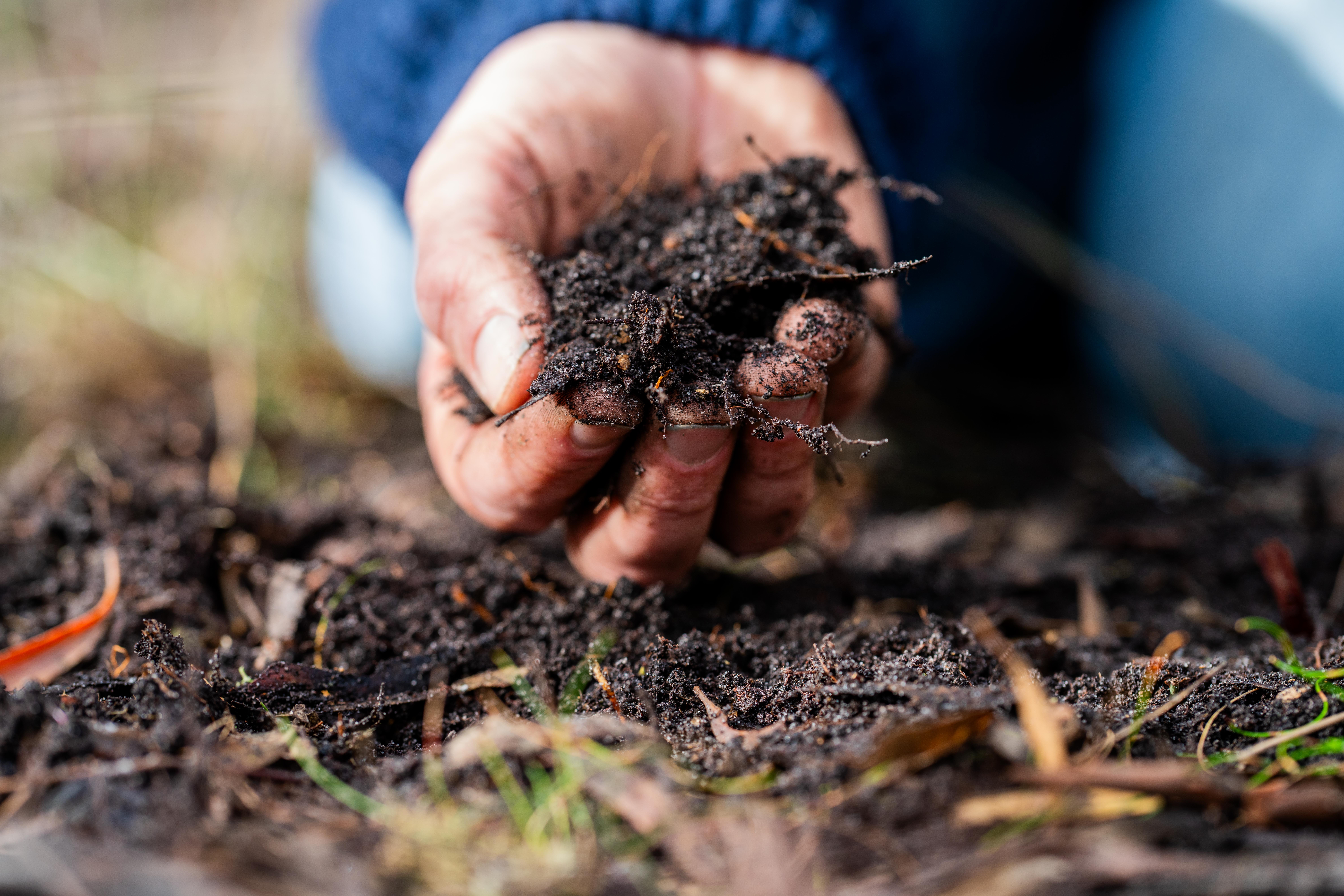
Observe a soil sample given to you by your teacher, and/or examine the image of soil.
Record your observations:
- What color is the soil?
- What textures or particles do you see?
- Are there visible pieces of organic material, such as leaves or roots?
Teacher Note: Encourage students to think about soil as a mixture rather than a single material.
As You Read, Think About:
- What is soil made of?
- How do the parts of the soil work together?
- Why does soil matter for plant growth?
What is Soil?
Soil is more than just dirt; it is a complex system made up of both organic and inorganic materials that support plant growth. Organic matter is made of once-living things like plants, animals, and microorganisms. As these materials break down through decomposition, they form humus, a nutrient-rich substance that helps store important nutrients plants need to grow. Inorganic matter comes from nonliving sources such as rocks and minerals. Over time, weathering and erosion break rocks into smaller particles that become part of the soil, while water and air fill spaces between soil particles. Soil forms slowly through the interaction of several natural factors, including parent material, climate, living organisms, location, and time. Understanding how soil forms and what it contains helps scientists and farmers protect soil health and grow healthy crops.
Check Your Thinking:
- What are the two main types of materials in soil?
- Can you give an example of each type?
T-Chart Time:
Create a two-column chart that identifies the organic and inorganic components of soil.
Teacher Note: Students may list items such as leaves, roots, microorganisms, rocks, minerals, water, and air.
How Soil Forms:
Did you know that soil forms through different environmental factors? The factors that influence soil formation are:
- Parent material
- Climate
- Organisms
- Topography
- Time
Think About It:
Teachers may wish to select 2-3 questions based on available time and student readiness.
- What is parent material, and why is it important in soil formation? Parent material is the original material from which soil forms. It can include bedrock, volcanic ash, river sediment, or material deposited by glaciers or wind. The parent material determines the minerals and texture present in the soil.
- How does weathering help create soil from rock? Weathering breaks rocks into smaller pieces through physical, chemical, and biological processes. As rocks break apart, minerals are released and become part of the soil. Over time, these particles mix with organic matter to form soil.
- Why does soil form more quickly in some climates than others? Climate influences temperature and rainfall. Warm, wet climates often speed up weathering and decomposition of organic material, which allows soil to form faster. Cold or dry climates usually slow these processes.
- What role do plants and animals play in soil formation? Plants add organic matter when leaves, stems, and roots decompose. Plant roots also help break apart rocks. Animals and microorganisms break down organic materials and physically mix the soil, contributing nutrients and improving soil structure.
- Why does soil formation take a long time? Soil formation involves slow processes such as rock weathering, accumulation of organic matter, and development of soil layers. These processes can take hundreds or thousands of years.
Reflection:
- What is one new thing you learned about soil?
- What surprised you the most?
Extension: Soil as a System
Here are some generalizations about systems.
- Systems have parts.
- Systems can change.
- Systems have inputs and outputs.
- Systems have interactions.
- Systems have boundaries.
Examples of systems in our world can include the human body, a playground, a store, etc.
Create a diagram that includes the following components about soil as a system. Use arrows to show the interactions and how nutrients move through the soil system.
- Organic matter
- Microorganisms
- Plant roots
- Water and nutrients
- Weather
- Human actions
Sentence Stems:
Use these sentence stems to support your diagram creation.
- “Soil is a system because…”
- “These parts interact by…”