
Investigating Soil Health
Observe and compare soil samples to identify characteristics of healthy soil. Examine texture, moisture, organic matter, and evidence of soil organisms and discuss how soil health affects plant growth.
Facilitation Tips and Potential Student Answers
Be sure to scroll to the bottom of the Educator Overview until you see STUDENT CONTENT BELOW THIS LINE. Interleaved in the Student Content section, you will see educator facilitation tips and potential student answers displayed in red, italic text when applicable.
Article Title:
Investigating Soil Health
Description:
Observe and compare soil samples to identify characteristics of healthy soil. Examine texture, moisture, organic matter, and evidence of soil organisms and discuss how soil health affects plant growth.
Target Grade Level:
Grades 5-8
Discipline or Course (Audience):
Physical Science, Earth Science, Life Science, Environmental Science, Biology, Agriculture, CTE, Sustainability, Civics
Time Frame:
One or two sessions of 45-60 minutes
Suggested Pacing:
Day 1: Reading, Discussion, and Lab
Day 2: Venn, CSI, Knowledge Check, optional extension activity
Suggested Grouping:
Individual or small group
Key Vocabulary:
soil, organic matter, inorganic matter, humus, microorganisms, minerals, soil formation, nutrients, soil ecosystem, regenerative agriculture, topography, weathering
Educator Background:
Soil is a living system made up of four key components.
- Minerals
- Air
- Water
- Organic matter (decomposed plants and animals)
Soil that is healthy can support crops, cycle nutrients, hold and move water, and support the living organisms.
To determine if soil is healthy, we look at several factors: structure, moisture balance, organic presence, and biological activity.
Materials:
- Device with internet access
- Notebook or digital document for recording observations
- Three different types of soil samples for each group. Be sure to have one unhealthy soil sample.
- Magnifying glass or hand lens
- Water droppers or small cups of water
- Paper towels
Recommended Student Background Knowledge and Skills:
Students should:
- understand that plants need nutrients, water, and sunlight to grow
- have basic knowledge of ecosystems and living organisms
- be familiar with observing and recording scientific observations
Special Population Accommodations:
Recommendations for supporting English Language Learner (ELL) students:
- Follow district guidelines for supporting ELL students.
- Consider sensory supports such as physical movement or podcasts.
- Use graphic organizers, anchor charts, and visuals to support and scaffold.
- Offer sentence frames and/or academic discourse stems for tasks such as explaining reasoning or comparing and contrasting ideas.
- Pre-teach vocabulary within the content.
- Pair with a peer buddy and assign a bilingual or high-proficiency English-speaking peer for support.
- Create opportunities for multiple ways to demonstrate understanding, such as through visual, oral, or written means.
- Model thinking out loud to showcase reasoning and problem-solving skills.
Recommendations for supporting Gifted & Talented (GT) students:
- Follow district guidelines for supporting GT students.
- Gifted students thrive when given choices and opportunities to explore the complexities of the content.
- Encourage students to explore across disciplines.
- Allow for opportunities for self-directed inquiry and research.
- Encourage reflection on learning strategies and thinking processes used.
- Provide executive functioning support and check-ins as needed.
Recommendations for supporting students with Individualized Education Programs (IEPs) and 504s:
- Follow the required accommodations based on the student's IEP or 504 plan.
- Provide small-group and individualized instruction as needed.
- Reduce cognitive load through chunking, scaffolding, and visual supports.
- Offer feedback frequently.
- Allow for extended time.
- Allow for breaks as needed.
- Provided modeled examples and clear single-step instructions prior to students engaging in independent or group work.
- Review evidence-based interventions providing support in small groups or individualized support as needed.
STUDENT CONTENT BELOW THIS LINE
Essential Question:
How do we determine if the soil is healthy enough to support crops?
Have you ever tried to grow something that didn’t survive, like a houseplant indoors or a bush outside? Why do you think some plants grow better than others? In this activity, you’ll think like a soil scientist to figure out what makes soil healthy enough to support plant life.
Figure 1: A farmer tests the soil
.jpg)
Materials:
- Device with internet access
- Notebook or digital document for recording observations
Safety Notes:
- When using technology, engage in safe, legal, and ethical behavior; this applies to devices (hardware), applications or programs (software), and interactions with others.
- When engaging with a soil sample, make sure to wash hands after touching the soil, and wash surfaces or containers that have been in contact with the soil. Do not eat or otherwise mishandle the soil.
How Do We Know If Soil Is Healthy?
Soil is made up of different materials. Let’s look at the diagram below to review the different parts of soil.
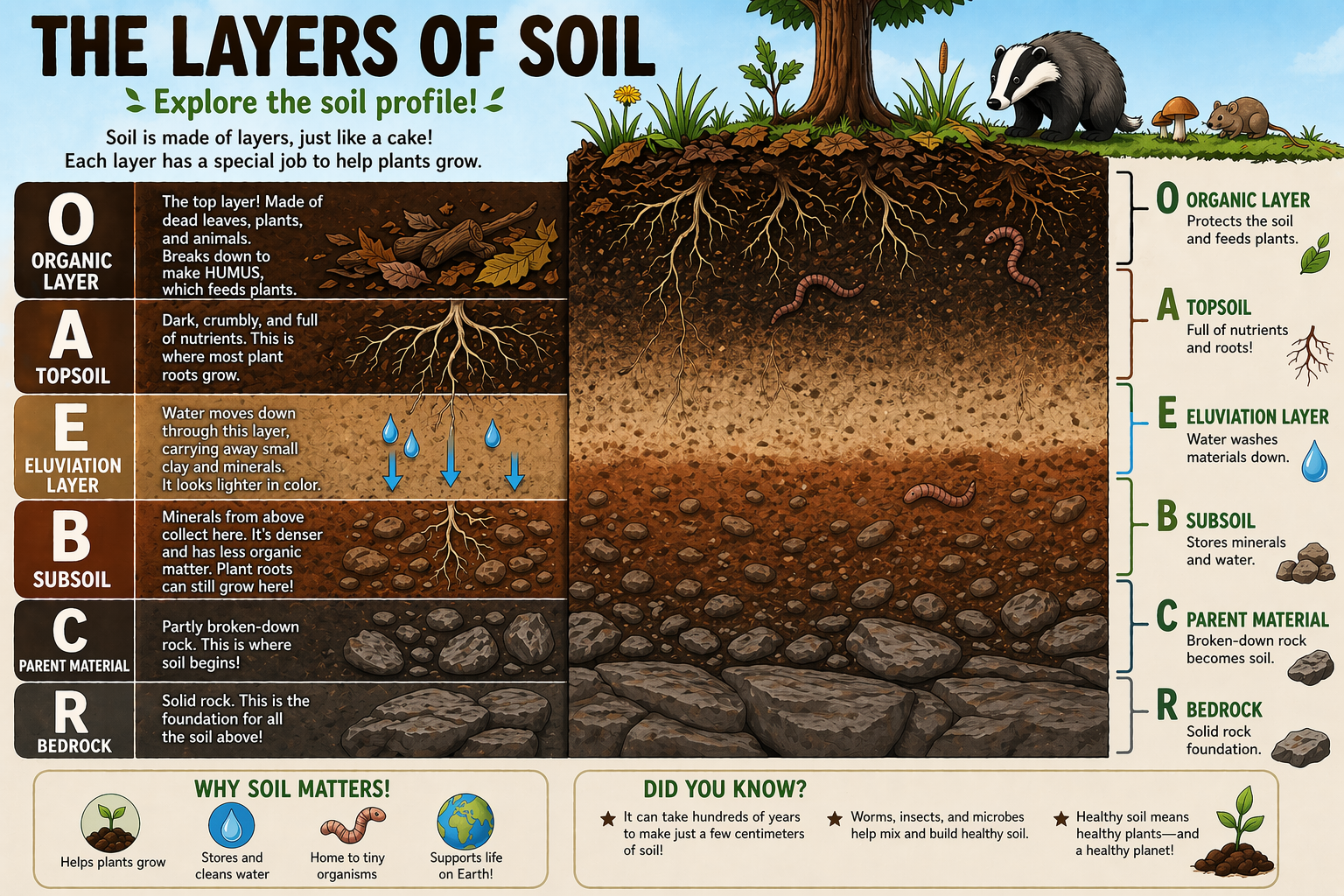
The right soil can help our crops grow strong and healthy. Unfortunately, some soil can make it very difficult for a plant to survive, let alone thrive. Soil scientists study soil to determine how well it supports life.
Healthy soil has a balance of air, water, and materials that plants need. Loose, slightly moist soil with organic matter, such as decomposing leaves, is healthy soil. If you find small organisms living in the soil, that can be an indication that the soil is healthy.
| What do you think makes soil unhealthy? |
What Should You Look For in Healthy Soil?
- Dark color
- Crumbly or loose texture
- A little moisture, but not too dry or too wet
- Organic material (roots, decomposing leaves)
- Living organisms (worms, beetles)
Let’s Observe: You will be given three examples of soil. With your group, look at each sample closely. Using your sense of sight and touch, notice the color, texture, and moisture level. Record your observations in your notebook (digital or paper).
Let’s Test:
After you’ve recorded your observations, it’s time to test each sample.
- Using the water dropper, add a small amount of water to each sample.
- Observe aeration:
- Gently press the soil.
- Record your observations.
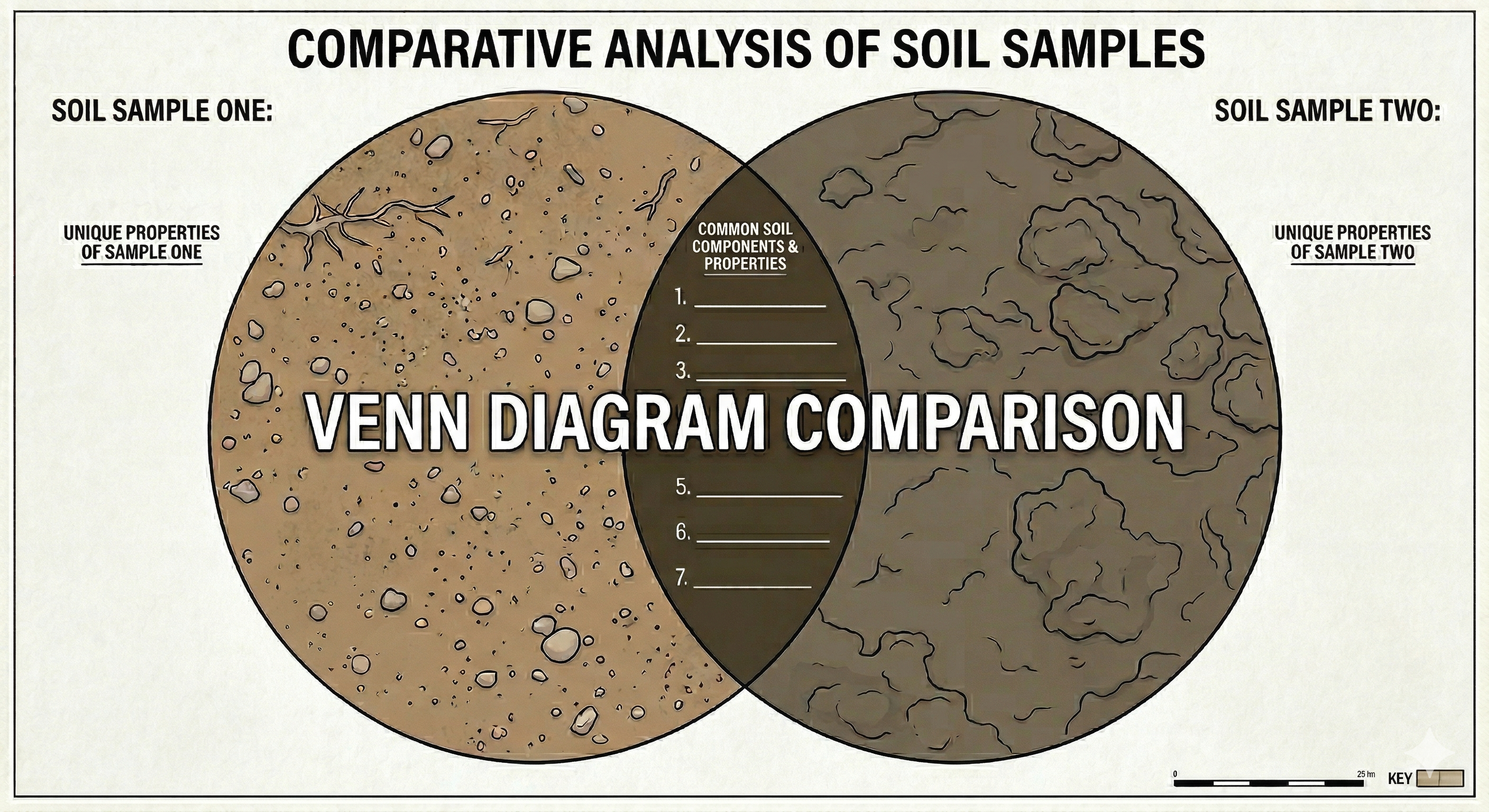
Venn Diagram:
Create a Venn diagram to compare and contrast two of the soil samples. Be sure to include similarities (center of the Venn diagram) and differences (outer areas of the Venn diagram). Use evidence from your observations to support your thinking. Be sure to include which soil appears healthier and why.
Figure 2: Venn diagram
Sentence Stems:
Use these sentence stems to support your notes in your Venn diagram.
- “This soil is healthier because…”
- “I observed that… which shows…”
- “The water behavior tells me…”
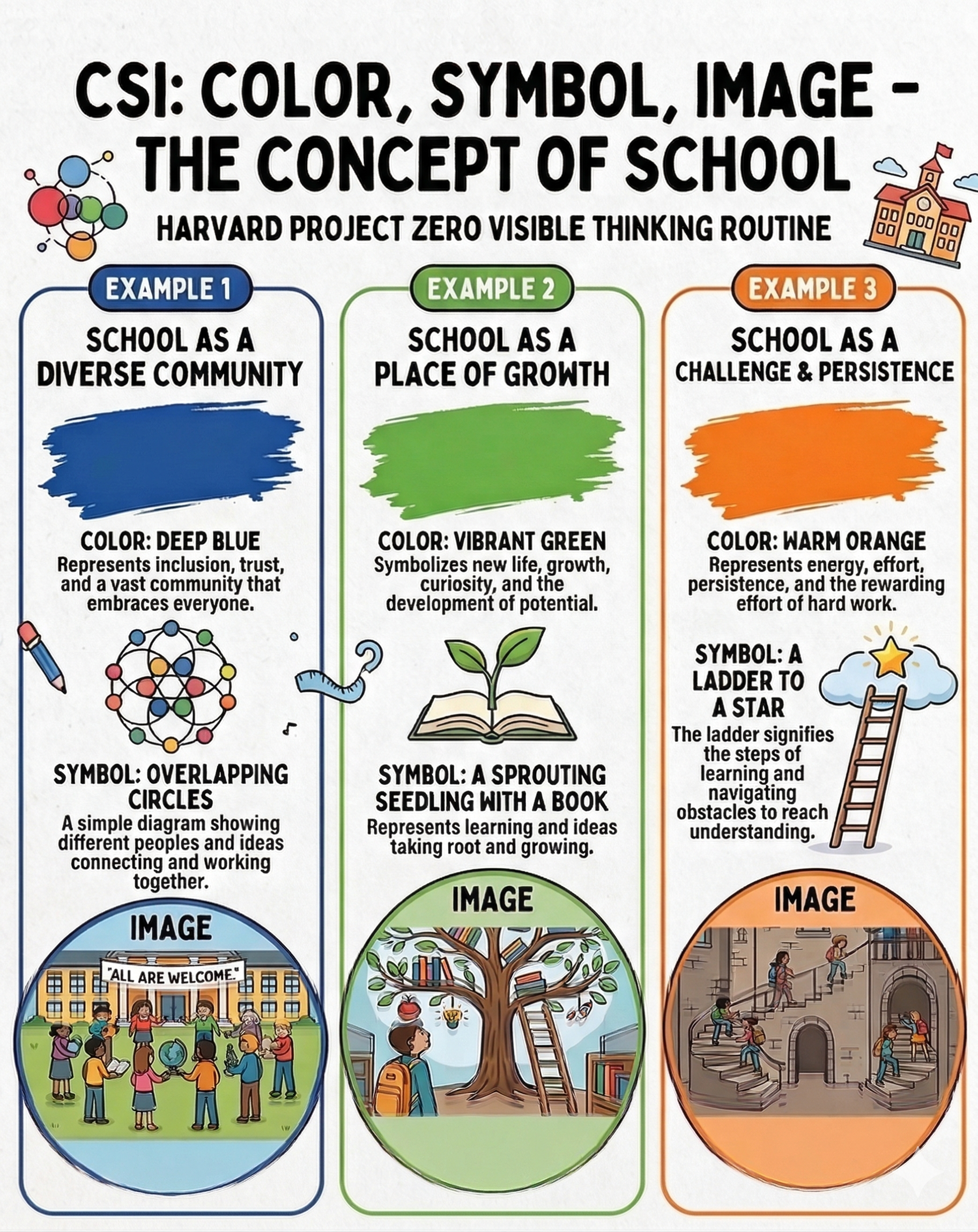
Color, Symbol, Image (CSI):
Figure 3: CSI for the Concept of School
Thinking About Soil
Thinking About Soil
Using the Project Zero CSI thinking routine, choose a color, create a symbol, and create or choose an image that represents soil. To support students who may need a reduced cognitive load, consider asking students to choose one or more areas of CSI.
Color
Think about what you’ve learned about soil and what it can represent to you. Explain your thinking: Why did you choose this color, and what does it represent?
Symbol
Design a symbol that represents what soil is. Think about the parts of soil and how it is a connection among living and nonliving things. Explain your thinking: What does this symbol represent? How does it show what soil is and does, and why that matters?
Image
Draw or choose an image that shows your idea of soil. What is taking place in the image? How does it show soil as a system?
Dive Deeper
How might your Color, Symbol, Image change depending on a different type of soil? If the soil was unhealthy or damaged, how might your CSI change?
Reflect on the Soil Investigation
Which soil sample seemed the healthiest? Why? What clues or observations helped you decide? How did observing the water interact with the soil help your decision?
Knowledge Check / Exit Ticket
What are three signs of healthy soil? Healthy soil is typically dark in color, crumbly or loose in texture, and will contain both organic matter and living organisms. Students' responses might contain ideas such as moist, roots, insects or worms, and a mix of particle sizes.
Why is soil structure important? It helps support root growth, helps plants get oxygen, and holds nutrients.
How does seeing how water interacts with soil help us to understand soil health? Water helps us to understand how aerated the soil is, which gives us clues to pore space and soil quality.
Reflection
What helped you to understand soil health? What was challenging? What would you do differently next time?
Extension
Choose one activity.
Choice One: Analyzing the Unhealthy Soil Sample
What was wrong with the unhealthy soil sample? What was it missing? What would you add or change to help the soil improve? Create a list or sketch of your plan to improve your soil sample. Possible Solutions: Students might improve drainage, add plants or organisms such as worms, or add compost.
Choice Two: Soil Recommendation
You are helping a gardener decide which soil to use. What would you recommend and why?