
How Plants Grow: The Science Behind Regenerative Farming
Explore the science behind plant growth, including photosynthesis, soil ecosystems, and nitrogen cycling.
Facilitation Tips and Potential Student Answers
Be sure to scroll to the bottom of the Educator Overview until you see STUDENT CONTENT BELOW THIS LINE. Interleaved in the Student Content section, you will see educator facilitation tips and potential student answers displayed in red, italic text when applicable.
Activity Title:
How Plants Grow: The Science Behind Regenerative Farming
Description:
Explore the science behind plant growth, including photosynthesis, soil ecosystems, and nitrogen cycling.
Essential Question:
How do systems in nature support plant growth, and how can regenerative farming improve that system?
Target Grade Level:
Grades 5-8
Discipline or Course (Audience):
Physical Science, Earth Science, Life Science, Environmental Science, Biology, Agriculture, CTE, Sustainability, Civics
Time Frame:
Two sessions of 40 - 50 minutes
Suggested Grouping:
3-4 students
Key Vocabulary:
Carbon dioxide, Humus, Inorganic matter, Microorganisms, Minerals, Nitrogen cycle, Nutrients, Organic matter, Photosynthesis, Regenerative agriculture, Soil, Soil ecosystem, Soil formation, Topography, Weathering
Educator Prep:
Background Knowledge:
Plant growth is dependent on connected natural systems that work together to give the plants energy, nutrients, and support. Photosynthesis is the process by which plants create their own food. They use sunlight, water, and carbon dioxide to produce glucose, which enables growth.
The soil ecosystem is a living system made up of minerals, water, air, organic matter, and microorganisms, including but not limited to fungi. These organisms will break down materials to help make nutrients for plants.
Regenerative farming helps to restore and support the healthy functioning of the natural systems that plants depend on. Farmers use practices like planting cover crops, reducing tilling, and adding organic matter (animal manure, hay, compost) to improve soil health and water retention. These practices help improve how energy and nutrients move through the system, allowing plants to grow stronger and healthier.
Materials:
- Printed or digital data
- Chart paper
- Soil samples (optional)
- Colored pencils or markers
- Internet access
- YouTube Video: Web Link - The simple story of photosynthesis and food - Amanda Ooten By Ted Ed
Recommended Student Background Knowledge and Skills:
- Plants need sunlight, water, and nutrients to grow.
- Understanding of ecosystems
- Familiarity with observation, asking questions, and recording ideas and data
Special Population Accommodations:
- Recommendations for supporting English Language Learner (ELL) students: Follow district guidelines for supporting ELL students. Consider sensory supports such as physical movement or podcasts. Use graphic organizers, anchor charts, and visuals to support and scaffold. Offer sentence frames and/or academic discourse stems for tasks such as explaining reasoning or comparing and contrasting ideas. Pre-teach vocabulary within the content. Pair with a peer buddy and assign a bilingual or high-proficiency English-speaking peer for support. Create opportunities for multiple ways to demonstrate understanding, such as through visual, oral, or written means. Model thinking out loud to showcase reasoning and problem-solving skills.
- Recommendations for supporting Gifted & Talented (GT) students: Follow district guidelines for supporting GT students. Gifted students thrive when given choices and opportunities to explore the complexities of the content. Encourage students to explore across disciplines. Allow for opportunities for self-directed inquiry and research. Encourage reflection on learning strategies and thinking processes used. Provide executive functioning support and check-ins as needed.
- Recommendations for supporting students with Individualized Education Programs (IEPs) and 504s: Follow the required accommodations based on the student's IEP or 504 plan. Provide small-group and individualized instruction as needed. Reduce cognitive load through chunking, scaffolding, and visual supports. Offer feedback frequently. Allow for extended time. Allow for breaks as needed. Provided modeled examples and clear single-step instructions prior to students engaging in independent or group work. Review evidence-based interventions providing support in small groups or individualized support as needed.
Remote Learning Adaptations:
This activity is appropriate for remote learning; no adaptations or modifications are necessary.
STUDENT CONTENT BELOW THIS LINE
Essential Question:
How do systems in nature support plant growth, and how can regenerative farming mimic those systems to improve soil and crop health?
Materials:
- Printed or digital data
- Chart paper
- Soil samples (optional)
- Colored pencils or markers
- Internet access
- YouTube Video: Web Link - The simple story of photosynthesis and food - Amanda Ooten By Ted Ed
Safety Notes:
- When using technology, engage in safe, legal, and ethical behavior; this applies to devices (hardware), applications or programs (software), and interactions with others.
- There are no anticipated physical safety risks associated with this activity.
How Do Plants Grow?
Think about the open spaces near you. Perhaps it’s your backyard, the community garden, or the area near your apartment.
Figure 1: A garden with flowering plants

Next, think about a plant in that space. Is there a pot filled with flowers on the balcony, or a tree with leaves filtering sunlight over the grassy area of your garden?
Figure 2: Deck and balcony plant examples


What does the plant you are imagining need to grow and flourish? Farmers ask these same questions every day. But what happens when the soil is not healthy or the system is damaged? Can plants still grow the same way?
Draw a quick sketch with labels of the plant or tree you are imagining, and label all the things it might need to grow.
Figure 3: An illustration of a tree system
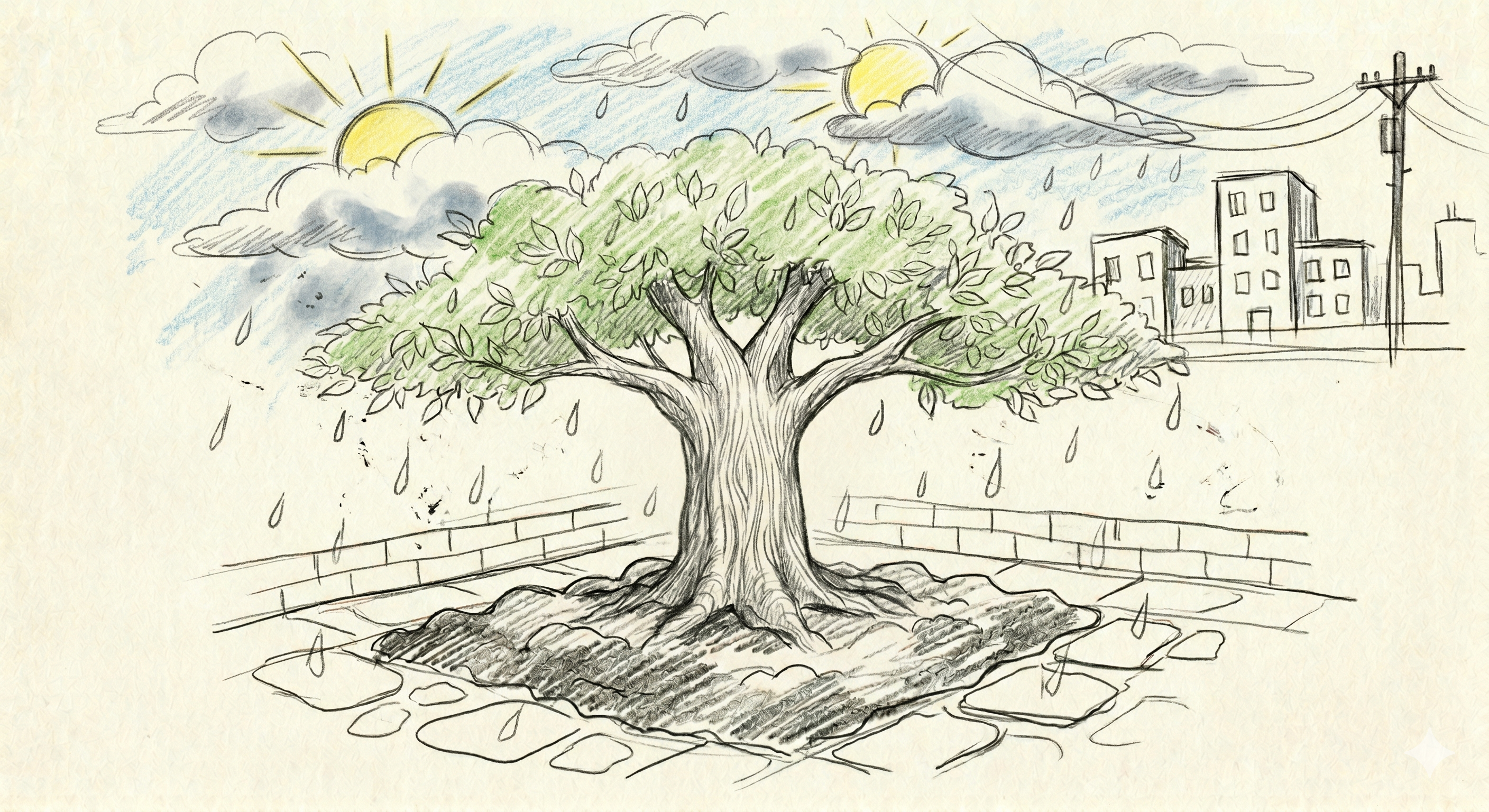
Did you label your drawing with sunlight, water, and soil? You might be surprised to learn that it is not a complete list of everything a plant needs to grow and thrive. Plants are part of living systems. Beneath the surface and inside every leaf is a process that is happening that allows the plant to grow.
Think About It:
- Where does a plant get its food?
- What is happening underground that helps a plant grow?
- What might happen if one part of the system is damaged or missing?
Share your ideas with a partner.
Were you aware that plants are foundational to our food system? Farmers depend on healthy plants to grow crops that feed communities. Unfortunately, not all farming methods help the soil. Some methods can actually break it down, leaving fewer nutrients for plants and making it difficult for plants to grow. Regenerative farming focuses on helping or restoring the soil, so plants have a strong natural system in which crops can thrive.
Diagram Analysis:
Notice and Wonder:
Let’s set the stage as you look at the diagram for the first time.
- What do you notice?
- What do you wonder about how this system works?
Figure 4: Plant Growth Connected to Systems
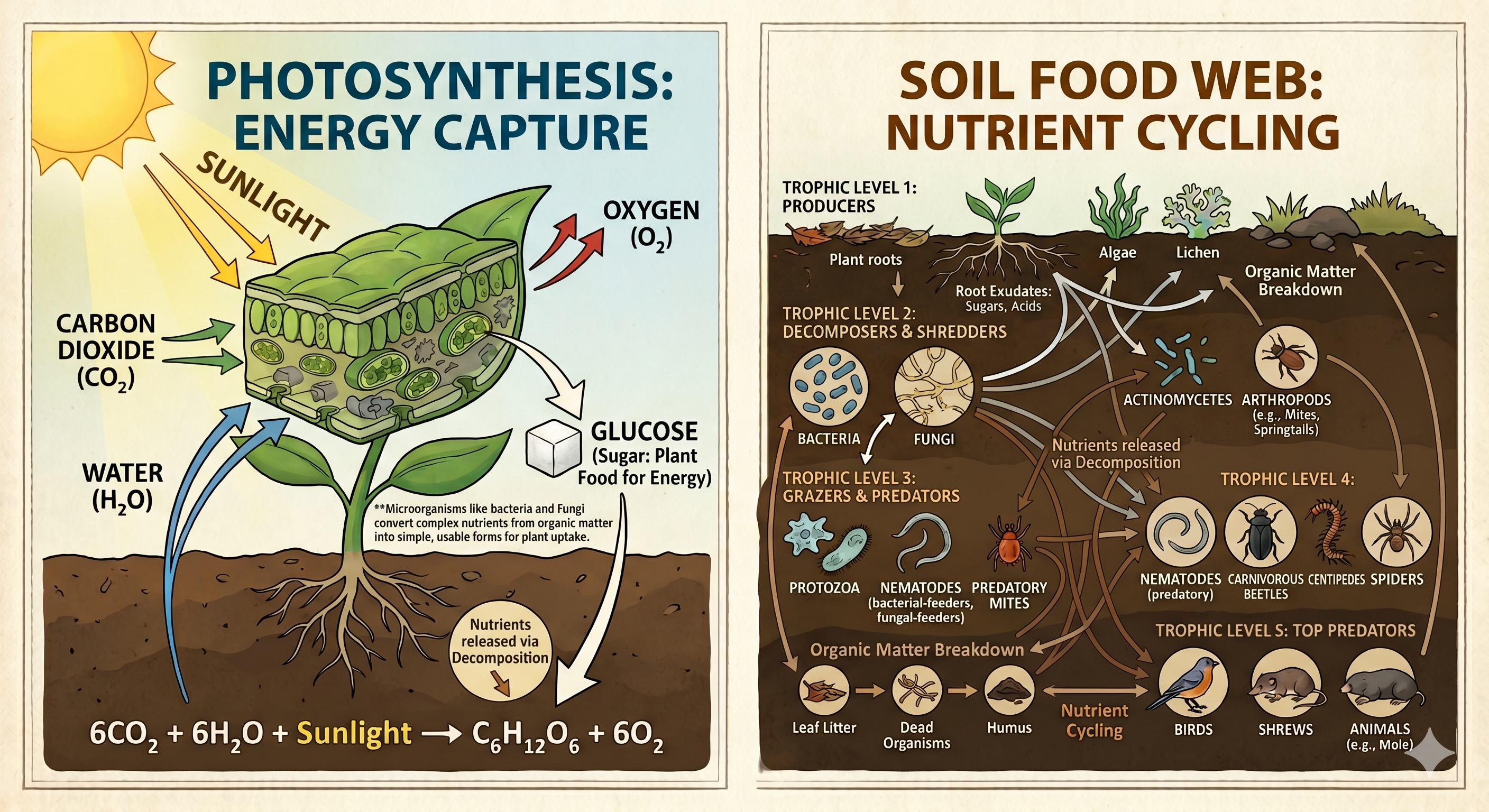
The diagram shows how plants grow using energy from the sun and nutrients from the soil. On the left, a plant takes in sunlight, carbon dioxide from the air, and water from the soil. Inside the leaves, the plant uses these to make glucose (food) and releases oxygen. This is photosynthesis.
Below ground, roots take in nutrients. Microorganisms like bacteria and fungi break down dead matter into nutrients. The soil food web shows how these organisms are connected, cycling nutrients back into the system as they die and decompose.
Observation:
Look at the diagram again and record your observations in your paper or digital notebook by filling out the table below.
| What materials are going into the plant? | What is the plant making or producing? | What is happening above ground? | What is happening below the surface? | What living organisms do you see in the soil? |
|---|---|---|---|---|
Photosynthesis:
Now that you’ve examined the diagram, let’s go deeper into how photosynthesis allows plants to grow.
Video Analysis:
Watch this YouTube video: Web Link - The simple story of photosynthesis and food - Amanda Ooten By Ted Ed
Take sketch notes or written notes in your notebook as you watch the video.
Systems:
Find evidence in the diagram and from the video of connected systems. Look for photosynthesis, the soil ecosystem, and the nutrient system.
- How does energy move in the systems?
- How do nutrients move in the systems?
Partner Discussion:
Discuss the following questions with your partner or small group:
- How does sunlight help plants grow?
- Why is decomposition important for plants?
- How are the systems that are above and below ground connected?
- What might happen if the soil system is damaged?
- Which parts of the system would be affected first?
- How might a farmer help restore or support these systems?
Teachers may wish to have a whole-group discussion to answer these questions.
Knowledge Check / Exit Ticket:
- What are the three main systems that support plant growth? photosynthesis, soil ecosystem, and nutrient cycling
- How does photosynthesis help plants to grow? Photosynthesis uses sunlight, water, and carbon dioxide to create glucose, which is plant food and provides energy.
- Why is soil a living system? It contains living organisms such as bacteria and fungi that break down organic matter. Soil also helps cycle the nutrients the plants need.
- How might regenerative farming improve the soil system to support plant growth? Regenerative farming will improve soil health by increasing organic material in the soil, restoring nutrients, and improving the structure of the soil.
Bringing It All Together:
In your notebook, write and/or sketch a short response to the following:
- How do natural systems work together to support plant growth?
- How might farming practices either harm or help these systems?
Be sure to include an example from photosynthesis and the soil ecosystem.
Looking Ahead:
In the next activity, you will explore how farmers use regenerative practices in real life and analyze how these practices can improve soil and plant growth. You will see how small changes in farming can have a big impact on the entire system.
Related Resources
-

Web Link
Learn about photosynethesis and it's relation to our food.
-

Diagram
An AI generated image of photosynthesis and the soil food web.
-
Diagram
An illustration of a tree with soil at its base, rain falling, and the sun coming out from behind the clouds