
Healthy Food and Community Food Systems
Explore how soil health, farming practices, and food choices are connected. Examine how local food systems support healthier communities and how organizations like FarmHero connect people with regenerative farms.
Facilitation Tips and Potential Student Answers
Be sure to scroll to the bottom of the Educator Overview until you see STUDENT CONTENT BELOW THIS LINE. Interleaved in the Student Content section, you will see educator facilitation tips and potential student answers displayed in red, italic text when applicable.
Activity Title:
Healthy Food and Community Food Systems
Description:
Students will begin to understand that healthy soil supports healthy plants, which in turn produce nutritious food, and that local food systems play an important role in community well-being.
Essential Question:
How do soil health, farming practices, and food systems work together to create healthy communities?
Target Grade Level:
Grades 5-8
Discipline or Course (Audience):
Physical Science, Earth Science, Life Science, Environmental Science, Biology, Agriculture, CTE, Sustainability, Civics
Time Frame:
45-60 minutes
Suggested Grouping:
3-4 students
Key Vocabulary:
conventional farming, industrial agriculture, intensive agriculture, and regenerative farming
Educator Prep and Background:
As students connect what they have learned about soil health and regenerative farming, they begin to see this system as part of a larger system that directly affects the food they eat.
Materials:
- Printed or digital data
- Chart paper
- Digital or printed notebook
Special Population Accommodations:
- Recommendations for supporting English Language Learner (ELL) students: Follow district guidelines for supporting ELL students. Consider sensory supports such as physical movement or podcasts. Use graphic organizers, anchor charts, and visuals to support and scaffold. Offer sentence frames and/or academic discourse stems for tasks such as explaining reasoning or comparing and contrasting ideas. Pre-teach vocabulary within the content. Pair with a peer buddy and assign a bilingual or high-proficiency English-speaking peer for support. Create opportunities for multiple ways to demonstrate understanding, such as through visual, oral, or written means. Model thinking out loud to showcase reasoning and problem-solving skills.
- Recommendations for supporting Gifted & Talented (GT) students: Follow district guidelines for supporting GT students. Gifted students thrive when given choices and opportunities to explore the complexities of the content. Encourage students to explore across disciplines. Allow for opportunities for self-directed inquiry and research. Encourage reflection on learning strategies and thinking processes used. Provide executive functioning support and check-ins as needed.
- Recommendations for supporting students with Individualized Education Plans (IEPs) and 504s: Follow the required accommodations based on the student's IEP or 504 plan. Provide small-group and individualized instruction as needed. Reduce cognitive load through chunking, scaffolding, and visual supports. Offer feedback frequently. Allow for extended time. Allow for breaks as needed. Provided modeled examples and clear single-step instructions prior to students engaging in independent or group work. Review evidence-based interventions providing support in small groups or individualized support as needed.
Remote Learning Adaptations:
This activity is appropriate for remote learning; no adaptations or modifications are necessary.
STUDENT CONTENT BELOW THIS LINE
The Journey from Soil to Community
Essential Question:
How do soil health, farming practices, and food systems work together to create healthy communities?
Materials:
- Printed or digital data
- Chart paper
- Digital or printed notebook
Safety Notes:
- When using technology, engage in safe, legal, and ethical behavior; this applies to devices (hardware), applications or programs (software), and interactions with others.
- There are no anticipated physical safety risks associated with this activity.
The Journey from the Soil to the Community:
Ever wonder how food makes it to your plate? Yes, it’s bought at a grocery store or convenience store, but how does it get there? The journey of your food actually begins in the soil. When soil is healthy with nutrients and living organisms, the plants or crops will grow strong. Farmers using soil practices such as composting, planting cover crops, and using fewer chemicals help grow healthier food for you.
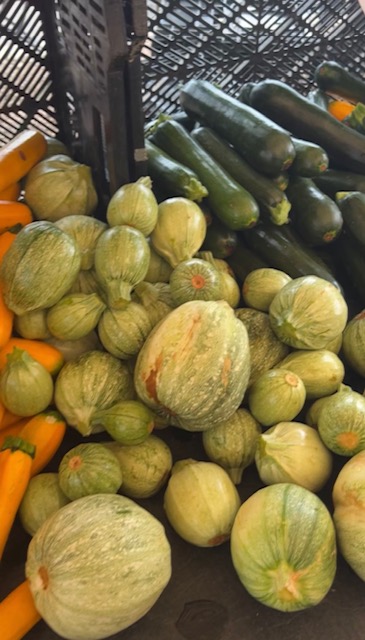
Once the food is grown, it moves through a large system of harvesting, processing, transportation, and selling. This is called a food system. Some food will travel thousands of miles to reach people. Have you heard of a Georgia peach or a Florida orange? These fruits travel from that state to be sold at your store. Other food systems are managed within a smaller region, helping food to reach communities quickly. Have you visited a local farmers' market? These farmers sell their products to nearby communities. This means the food is typically fresher.
Figures 1: Fresh vegetables at a local farmers' market
|

|
Did you know that there are production companies across the nation that are meeting farmers who are using regenerative practices to bring fresh food to our communities? You can explore more by visiting the website: Web Link - Farm Hero |
Mapping Two Food Systems:
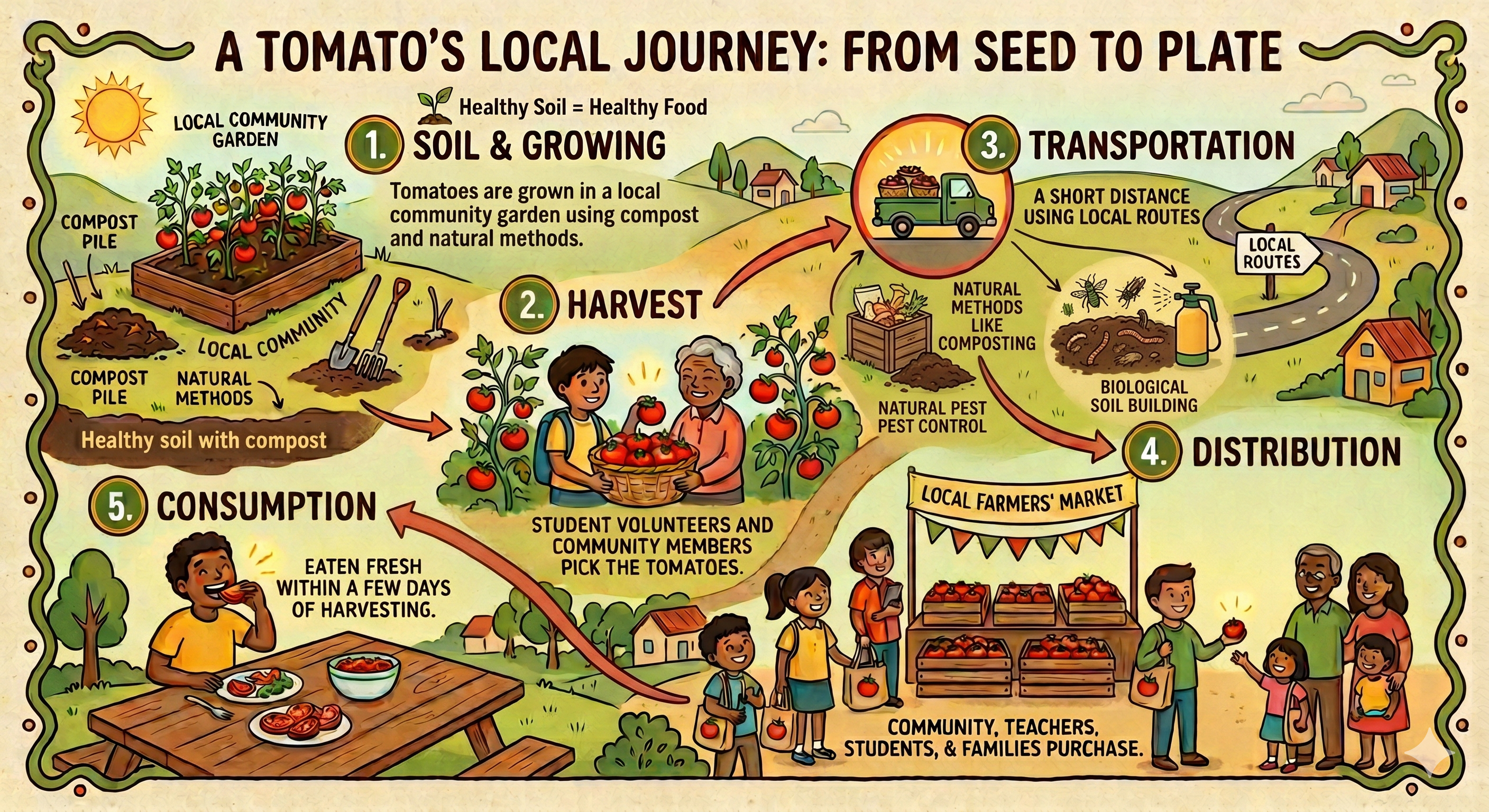
Let’s consider your local community garden. This garden sells tomatoes at the local farmers' market. If we look at the journey of the tomato, we see:
- Soil and Growing: The tomato is grown in a local community garden that uses compost and other natural resources and methods.
- Harvest: Student volunteers and community members pick the tomatoes.
- Transportation: The tomatoes are driven a short distance.
- Distribution: Members of the community, teachers, students, and families purchase from the local farmers' market.
- Consumption: The tomato is eaten fresh within days of harvesting.
Figure 2: The Local Journey
Now, let’s imagine conventional farming (also called intensive or industrial agriculture) from the farm to the supermarket.
- Soil and Growing: The tomato is grown in a large field or farm using highly efficient machinery, irrigation, and chemicals to treat pests.
- Harvest: Massive amounts of the crop are harvested by machines and/or human crews and collected into bins for processing.
- Transportation and Processing: The tomatoes are delivered to a processing plant where they are sorted, cleaned, graded, and packed into boxes.
- Distribution: They are then driven throughout the nation to central distribution hubs, and then delivered to community grocery stores.
- Consumption: The tomato is eaten days or even weeks later.
Your Turn:
Choose your favorite fruit or vegetable and create a food map showing the journey it would take if grown locally or in another state.
Be sure to include:
- Where it is grown
- Farming methods used
- Harvesting and processing methods
- Transportation and distribution methods and locations (including the distance it travels)
- Your location, where the food is consumed
- Estimated time from harvest to consumption
Thinking Deeper: What Impacts Your Food?
In your own words, record your thinking in your journal:
- How does soil health affect your food?
- What farming practices might be used to grow your food?
- How could those farming practices help or harm the land, the food, and you as a consumer of the food?
Knowledge Check / Exit Ticket:
- What is a food system?
- How does soil health impact the food we eat?
- What is one difference between a local food system and a distant food system?
- Why do farming practices matter to our communities, our health, and the environment?
Extension:
Choose one activity to complete as an extension.
Choice One: What If?
Think about the food systems we mapped together. Identify one part of the food system and consider what would happen if that one part encountered a barrier or failed. Create a troubleshooting guide showing what would happen or how one might pivot if that part of the system failed. Be sure to explain how this would impact other parts of the system.
Choice Two: Perspective Writing
In our food systems map, we looked at different roles people and businesses take on. Choose one of the roles and write a journal entry explaining your role and why you are an essential part of the system. Role examples include: farmer, truck driver (roustabout), farmers’ market owner, consumer, etc.
Related Resources
-

Diagram
A stand holds summer vegetables for sale at the local farmers market.
-
Diagram
Follow a tomatoes journey from the community garden to the local farmers market.