
A JASON Learning Honorary Argonaut and STEM Role Model Spotlight
Great expeditions are built on the passion, generosity, and expertise of extraordinary people. Leia Hall embodied all three during the 2026 Houston Liftoff Expedition. In recognition of her remarkable contributions, JASON Learning is honoring her as an Honorary JASON Argonaut, alongside her role as host scientist. The Houston Expedition, like every Argonaut program, runs on scientists willing to open their world to students. Leia Hall did that this June, and eight Argonauts got to experience Houston’s STEM community because of it, guided by someone who helps chart the way for astronauts headed to the Moon.
Five Days, Multiple Sites, One Through-Line
The Houston 2026 Expedition packed a career’s worth of STEM exposure into five days:
- Monday, June 22: Arrival in Houston, orientation, and the Argonauts’ first hands-on test of their field databots.
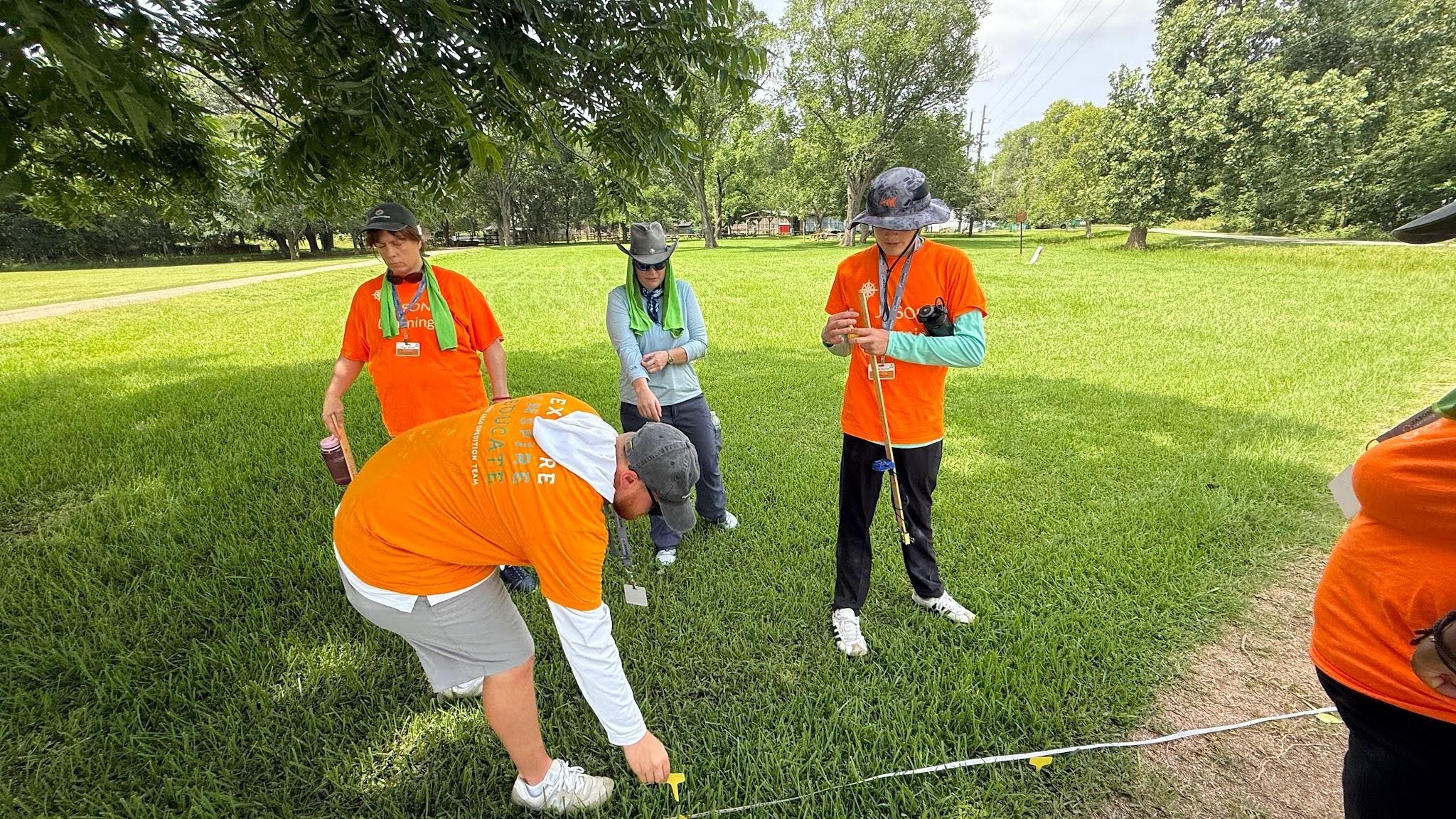
- Tuesday, June 23: A day at the Houston Advanced Research Center (HARC), collecting real environmental data on-site alongside working researchers.
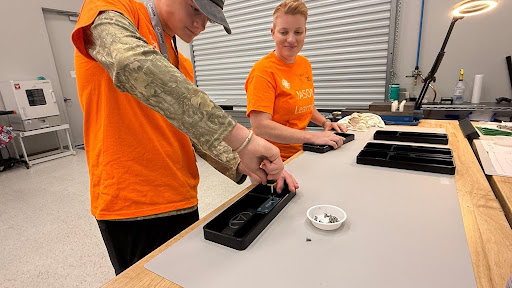
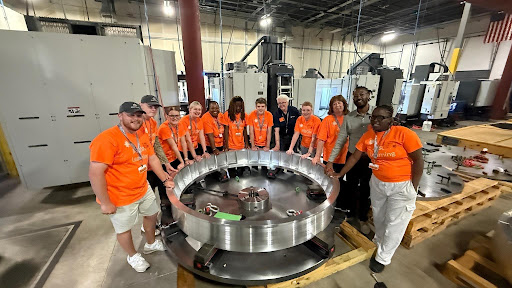
- Wednesday, June 24: Coastal ecology data collection and education at Armand Bayou Nature Center, followed by an engineering-focused visit to Arrow Science and Technology, including a talk from Jim Baker on his own STEM career path.
- Thursday, June 25: Continued data collection and analysis across HARC, Armand Bayou, and Arrow Science and Technology, capped off with an evening spent prepping posters for the team’s research presentation.
- Friday, June 26: A morning at NASA’s Neutral Buoyancy Laboratory and Johnson Space Center Mission Control, an afternoon poster session at the University of Houston–Clear Lake, and a celebration dinner at Kemah Boardwalk to close out the week.
Every one of those days needed someone who could translate real, working science into something the eight Argonauts could dig into hands-on, someone who knew the research, had experience with local data collection, and knew how to make a scientist’s world make sense to a student or educator encountering it for the first time. That someone was Leia Hall, the expedition’s Host Scientist.
How It Started
None of it happens without background knowledge and meticulous planning. Argonaut Expedition Leader Jude Kesl had met Leia on a past expedition to Houston, back when Leia worked for NASA. Almost two years later, with fingers crossed, Jude reached out to her through LinkedIn on the chance she was still local to Houston and might have time to spare to help design the Argonaut Liftoff Expedition. Leia was on board immediately, and the hard work of designing and planning expedition content began.
Leia joined the expedition planning team in January 2026. It quickly became apparent that JASON Learning was working with one of its newest STEM Career Role Models.
A Career Built for This Work
Leia’s path to the Argonaut Expedition began in the U.S. Navy Reserves, where she served as a Gunner’s Mate from 2007 to 2013, including a deployment to Afghanistan in support of Operation Enduring Freedom. While serving, she earned a bachelor’s degree in Mathematics with a minor in Geoscience from Midwestern State University.
From there, her career became a study in spatial data. She worked as a Geological Technician and Data Analyst building Geographic Information Systems databases for oil and gas fields, then as a Lidar Data Analyst generating 3D maps from field-collected data, and then as an Aircraft Data Analyst digitizing and modeling runway chart data for Foreflight, a Boeing company. In 2019, she completed a Master’s degree in Geosensing Systems Engineering and Sciences at the University of Houston, along with a Graduate Certificate in GIS.
In 2020, Leia joined KBR in Houston supporting International Space Station operations, monitoring the station’s command and data-handling systems and completing two years of flight controller training. In 2022, she stepped into a role as Lunar Surface Navigation Lead for NASA’s Artemis program, designing the geospatial tools and navigation systems astronauts will use to move across the lunar surface — work recognized at NASA management meetings as among the program’s top data-driven solutions. Alongside that work, she became a certified Extravehicular Activities Flight Control Instructor, training flight controllers on the spacesuit and airlock systems that keep astronauts safe outside the spacecraft.
Today, Leia is a Guidance, Navigation, and Control Test and Verification Engineer at Moonshot Aerospace, developing test plans and verification procedures for navigation systems in support of lunar missions.
Why It Matters
JASON Learning’s Argonaut expeditions exist on a simple belief: students don’t just learn science — they should get to live inside it, even if just for a week. That belief only becomes real when a working scientist is willing to step in and shape what that week actually looks like — choosing the right sites, framing the right questions, and making sure the science students encounter is real, not simulated.
As Host Scientist, Leia did exactly that — bringing a career spanning military service, geospatial engineering, ISS operations, and NASA’s Artemis program directly into the way this expedition’s content was designed. For the twelve students who spent a week collecting environmental data, meeting STEM professionals, and presenting original research, that meant working alongside someone who quite literally helped map the way for astronauts headed to the Moon.
In Her Own Words
“Serving as the Host Scientist and a student mentor for the 2026 Houston Liftoff Expedition was an extremely rewarding milestone in my career. My goal wasn’t just to hand these students a pre-packaged version of data collection and analysis tools; it was to give them the keys to a real, working scientific world and challenge them to dig into it firsthand and learn to ask questions. When you prompt a student with a tough question and watch them start to interrogate their own assumptions, or when you guide an educator through translating complex concepts into an accessible tool, you see a spark catch fire. It pushes everyone involved to drop the standard, rigid frameworks, look entirely outside the box, and realize that science isn’t just a static topic in a textbook, but it’s a dynamic, living playground where they actively belong.”
“Watching the Argonauts connect with the broader Houston STEM community reminded me exactly why I fell in love with the concept of scientific exploration and discovery. I wanted to show these students that no matter where you start or what barriers people try to put in front of you, curiosity and persistence are what actually map the path forward. By throwing fresh, challenging real-world problems their way, whether we were troubleshooting lost or corrupted data, learning new concepts real-time, or finding ways to work around problems, we built an environment where it was safe to struggle, pivot, and innovate. Inspiring the next generation of thinkers and giving curious educators a renewed sense of invigorated passion was never about sharing what I know, it was about broadening perspectives together so that we all walk away eager to ask the next big question and dive into new problems head first.” – Leia Hall
What the Argonauts Are Saying
“One thing that always stood out to me about Leia was when you would ask a question, and she would question you back. It always made me think harder, and I loved when she would do it. She was so funny and a great person. Despite her being sick on the first day, she still willingly helped us. And that had made me feel very inspired to be like her.” – McKenzie, Houston 2026 Student Argonaut
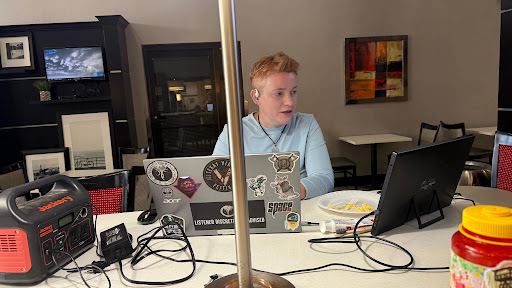
“A specific moment I remember about Leia is when me and the other argonauts were going from our rooms to the gym downstairs, we saw her still trouble shooting the graphs for our data even though she had just got out of the hospital the previous night from food poisoning. This showed me she wasn’t doing this for anything of her own benefit, but because she truly wanted to help us. Her passion for STEM inspired me and all of the other Argonauts. I have never met someone with such pure intentions to teach others what they love the most. This was apparent to me especially when she told us the hardship she faced, she came from an environment where nobody told her she would be able to do what she truly wanted. Despite the remarks her own father and her counselor had for her she persevered. This is a person I will truly never forget and will have a lasting impact on personal life and my career forever.” – Jakobe, Houston 2026 Student Argonaut
“Leah was a great mentor and she helped guide us with all the hard coding bits. She showed me my first python script and got me really interested in it even though it’s super complicated. She even helped guide us through NASA and explained everything really well. Leah’s already an Argonaut we should just make it official.” –Dylan, Houston 2026 Student Argonaut
“People always tell me that I have to be persistent in doing something I want. I used to always try once and not really try again because I hated failing at something. Leah made me realize that what people say is true. Her persistence in messaging NASA once every three months for FIVE years has strongly inspired me to not give up in fear of being denied. Especially her devotion to getting back to NASA.” – Grace, Houston 2026 Student Argonaut
“Along with the amazing and once in a lifetime NASA experience, as well as being our main problem solver and coordinator for visualizing our data, Leah truly helped motivate me to do more with my experience. We had a good conversation at Arrow about having a growth mindset when pursuing your future career, and our conversation during the poster presentation really expanded my desire to do more with my research and see what ways it can help positively impact my community. I am very glad she was able to be a part of our expedition and my future outlook would not be the same without what she shared.” – Vance, Houston 2026 Student Argonaut
If you’re an educator, researcher, or professional interested in helping shape the next Argonaut expedition, visit https://jason.org/argonauts/ to learn more about the program and past expeditions or email JASON Learning at info@jason.org with subject line: Argonaut Expedition Inquiry.
JASON Learning’s Argonaut expeditions connect students directly with scientists, engineers, and researchers doing real work in the field. Follow our journeys at #JASONArgonauts.